Brief description
A vast fake-documentary universe about a 1959 disappearance, spanning VR, AR, live cinema, gallery installation and online fiction to question how audiences determine truth.
Full description
Whilst the Rest Were Sleeping was a large-scale transmedia artwork created, written, directed and produced by Simon Wilkinson and released under circa69. It centred on a fictional mass disappearance in 1959. Eight students aged 17 and 18 from a college in Idaho travelled with their science teacher and never returned. After two weeks of searching, eight letters written by the missing young people were found laid neatly on a table inside a black cube-shaped shack ten miles into the Great Basin Desert, approximately two and a half hours from the college. The bodies of the eight students and their teacher were never found.
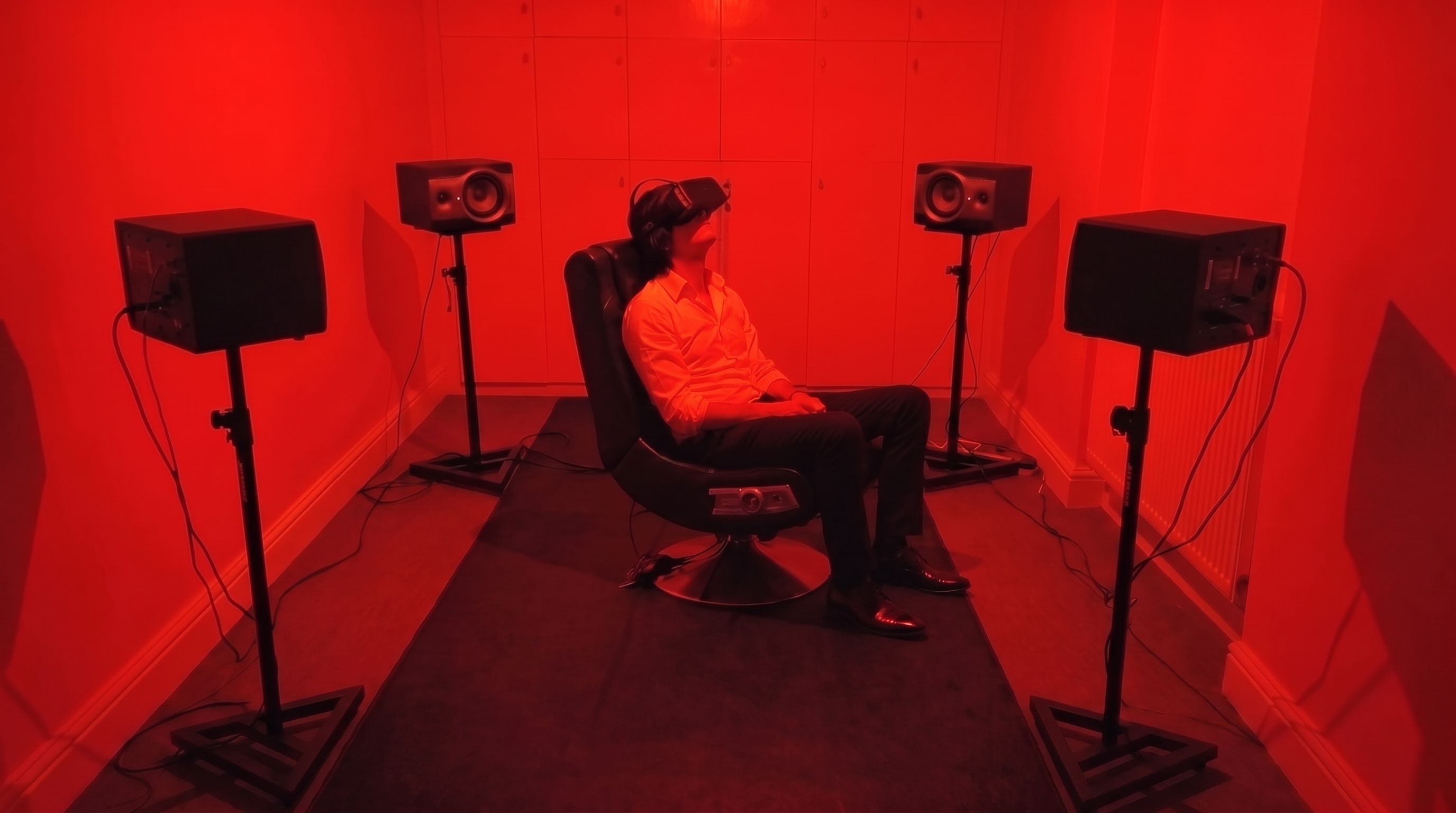
The project was presented as documentary rather than fiction, and the audience not knowing they were being pranked was fundamental to the work’s effect and meaning. Depending on the venue, it could operate as a full takeover or as one or several individual components. In its total form it comprised 17 virtual-reality installations, an augmented-reality experience, a feature-length documentary film performed live with electronic music, string quartet and eight performers, a gallery exhibition, and a large online transmedia universe containing around 35 fake Wikipedia pages, websites, social-media groups and other breadcrumb trails.
The work toured internationally between 2014 and 2018 to 21 nations: Australia, the United Kingdom, Canada, Mexico, Peru, Venezuela, Argentina, New Zealand, South Africa, Kenya, Germany, Belgium, Bosnia, Denmark, Italy, the Netherlands, Serbia, Turkey, Armenia, Qatar and Estonia. Presentations were commonly accompanied by a public lecture and media interviews about propaganda. The project also toured with early commissioned versions of Immersive Story Lab, a professional-development programme teaching artists to create immersive, playable, player-centred stories for VR. The overarching concern was how people decide what is true in a world defined by paid-for messages, propaganda and advertising.